





Diamond Polishing Pads
Diamond Polishing Pads for Professional Finishing
Diamond polishing pads transform rough stone, concrete, and masonry surfaces into smooth surfaces. A diamond pad for polishing does not cut material away as a grinding wheel does, but rather uses a series of grit stages to smooth out scratches from the previous grit. If you're installing granite countertops, refinishing a terrazzo floor, or reviving an old concrete slab, you’ll get a surface with real depth and shine.
These pads are designed for use on natural stone (granite, marble, travertine), engineered quartz, terrazzo, and concrete. Marble and travertine are easy to scratch and will respond well to lower pressure and finer grits in the early stages of the sequence. Before you move into the polishing range, granite and engineered stone can withstand more aggressive grinding. If you are stripping old coatings or smoothing out imperfections, a longer run through the coarser grits is usually required.
Grit levels typically start at around 50 for heavy material removal and climb through 100, 200, 400, 800, 1500, 3000. Some polypad options even go up to 6000 or 12000 grit for a true mirror finish. Lower numbers cut faster and remove more material. The higher numbers smooth out the surface and increase reflectivity. One of the most common job-site pitfalls is skipping the grit stages. If you jump from 100 to 800, you will be spending twice as long as it takes you to buff out scratches that a good 200 or 400 pass would take minutes.
Types and Grit Levels Explained
Pads are available in dry and wet formats. Dry diamond pads are designed to be used without water, making them ideal for indoor applications, confined areas, or situations where water cleanup is not feasible. Wet pads stay cooler when rubbed. It prolongs the life of the diamond segments and gives a cleaner cut on harder stone. Some dry pads are specially designed to withstand dry conditions without overheating. Others, like the Proxxon diamond coated sanding and polishing pads, are suitable for detail work where control is more important than speed.
Hand pads serve a different purpose than machine-backed pads. A diamond-hand polishing pad lets you control corners and areas a grinder can't reach. For instance, the Alpha diamond hand pad 7-piece set includes a complete grit kit for this level of detail work. Individual hand pads in specific grits can be used to touch up problem areas without using a full set.
How to Choose the Right Polishing Pad for Your Project
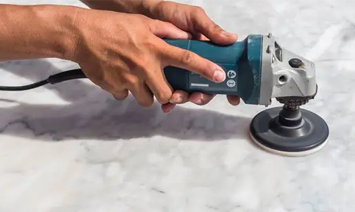
Start with the material and the surface condition. If there are deep scratches or old adhesive residue, begin with 50- or 100-grit. If the surface is already smooth but lacks luster, it may require only 400 grit, or possibly as high as 600 grit, to restore it. Check the diameter of the pad to make sure it fits the tool (4", 5", 7"). Make sure that the arbor or hook-and-loop attachment is compatible with the grinder or polisher.
Move the pad flat against the surface. Use a steady, overlapping motion. Avoid staying in one position, as diamond pads will wear down quickly under pressure and may cause uneven low spots if you stall. Maintain steady speed and let the grit do the job; don't push down harder.
The lifespan of the pad is dependent on usage. A dry pad on concrete or other hard rock will wear out more quickly than a wet pad on softer stone. Wet pads after each use and allow cool pads to chill between passes to avoid glazing (when the diamond segments overheat and lose their cutting edge).
Diamond Polish Pads Ready for Tough Work
Tool Academy stocks a wide selection of diamond polishing pads in all grits and sizes that a tiling or concrete crew will require. The tools represent trusted brand names, including Sigma, Proxxon, Alpha, Walter, Dremel, and Tooltech. Our team has extensive knowledge of tiling tools, so don’t hesitate to contact us if you need help in choosing the right tool for your project.
