




Spacers & Wedges
Tile Spacers and Wedges for Even Grout Lines
Straight grout lines depend on small parts doing the same job at every joint. As the thinset dries, the 1/8" gap left by the tile spacers remains 1/8" along the entire length of the doorway. Wedges cover what a fixed spacer can't: closing a joint by a fraction, holding wall tile, or locking a levelling clip down. This collection includes both, in sizes from 1/32" to 3/8", packed in 50-piece bags and up to 2,000-piece jars.
Cross Spacers, T Spacers, and Tile Wedges
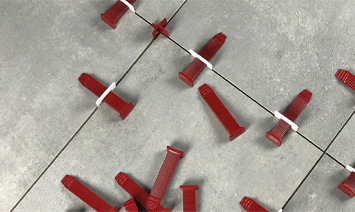
A cross spacer is used at the intersection of four corners and helps adjust the joint in opposite directions. T spacers are used at three corners of each tile and occur at every joint in a running bond pattern. Use L-type spacers for corners and border cuts.
U shims (horseshoe spacers) slide in from the edge. Use them to shim a low tile or under the first row of wall tile. The color coding saves time on a busy job: blue is 1/16", red is 1/8", yellow is 3/16", and black is 1/4".
Tile wedges are tapered plastic pieces. Push one into a joint; it will set any gap within its range. A 0-5 mm wedge covers every size in that band. Tile leveling wedges are a different part. Through a leveling clip, they slide and push adjacent tiles into the same plane, minimizing lippage on large-format porcelain.
Choosing Spacer Size for Your Tile and Grout Joint
Let the tile determine the joint. ANSI A108.02 sets the minimum grout joint at three times the variation in the face dimensions of the tile, and never under 1/16". Before picking, measure a few tiles from the box.
-
1/16 tile spacers: rectified wall tile, polished marble, and tile with very consistent edges.
-
1/8 tile spacers: the most common floor size, and the ANSI minimum average for rectified large-format tile in running bond.
-
3/16 tile spacers: calibrated (non-rectified) tile, handmade tile, and anything with uneven edges.
-
1/4" and up: quarry tile, terracotta, and outdoor pavers.
Most joints less than 1/8" will require unsanded grout. Check the joint range on the grout bag.
How to Use Tile Spacers and Wedges
Snap layout lines and position the first row to the line, not the wall. Use the spacer at every corner when installing each tile. Installers often place cross spacers on end, with one leg in the joint, then pull them out. If it's a wall, put horseshoe spacers or wedges under the lowest row to support it and leave a caulk space above the tub.
Use a straightedge to check joints every few rows. If the line is drifting, tap in a wedge as the thinset is still soft. Once the tile is set, pull spacers. Remove the leveling clip heads from the mortar once it has cured, using a rubber mallet.
Tile Spacer Brands Stocked in One Place
Tool Academy carries Rubi spacer jars of 1000, Tavy cross and T spacers in various sizes, Raimondi leveling clips and wedges, QEP horseshoe shims, Perfect Level Master reusable spacers and T-Lock wedges, as well as Sigma, Russo, Pro Tile and Peygran. Our staff has hands-on tiling experience, so ask which spacer would be suitable for the type of tile you are using, and you'll get professional help.
Frequently Asked Questions
What size tile spacer should I use for 12x24 tile?
ANSI A108.02 recommends an average joint width of 1/8" for rectified 12x24 porcelain and 3/16" for calibrated 12x24 porcelain, plus the tile's edge warpage. Do not exceed an offset of 33%.
When should I use T spacers instead of cross spacers?
For running bond and brick patterns, use T spacers in places where joints overlap in a T. For cross bond, use cross spacers where four corners meet.
What are tile wedges used for?
Wedges adjust joint width, secure wall tile in place, lift low tile, and lock leveling clips to prevent tiles from curling up.
Should I remove tile spacers before grouting?
Yes. A space in the joint will leave a thin layer of grout over it, and that may crack or show a shadow.
Can I use spacers with a tile leveling system?
Yes. The most common leveling clips have the thickness of their base, as in the 2 mm and 3 mm leveling clips here. Use spacers at corners where there is no clip; the size should match the clip.