



Concrete Chisels
Concrete Chisel Bits and Their Applications
When it comes to heavy-duty tasks your arms can't handle, a rotary hammer chisel bit does the job quickly and easily, whether you are breaking up concrete, chipping mortar joints, or removing tile from a subfloor. These bits fit into an SDS-plus or SDS-max rotary hammer, and convert repeated hammer strokes into controlled, focused power. That force wears away concrete, brick, block, mortar, asphalt, and even clay without even having to swing a sledgehammer all day long.
A hammer drill chisel bit is no simple tool. Widely flat chisels are used for stripping flooring and coatings in a demolition job. When installing conduit runs, electricians and plumbers resort to pointed bits to pierce through the slab. Porcelain and ceramic tile setters employ special tile chisels to lift porcelain and ceramic without cracking the underlying surface. Every shape has a specific purpose and selecting the incorrect shape wastes time and wonks out the bit faster than it's supposed to.
Chisel Types, Shapes, and Shank Compatibility
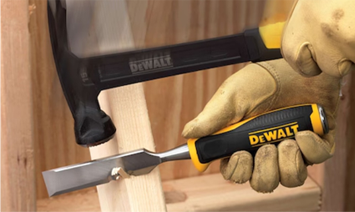
Flat chisels leave a wide, clean cut. They are used for scraping floors, chipping mortar joints, and breaking concrete following a specified edge. They are the first tool any general contractor reaches for, since they're used for general demolition.
Pointed chisels (also known as bull points) focus the force in a small tip. That's why they're a better option for starting a hole before transitioning to a flat bit or spade bit, or for breaking through solid concrete. For concrete, a pointed bit wins for breaking mass, and a flat bit wins for finishing the surface.
Scaling chisels have a curved or angled edge, designed to peel back thin layers, old glue, paint or surface coatings without damaging the material underneath.
Tile chisels are wider and flatter than standard chisels. There’s a self-sharpening edge on some chisel models (see the SDS MAX Tile Chisel, Self-sharpening 2"x 11-1/2). They are designed to go under tile and then release it in small bits.
Shank compatibility matters, too. SDS-plus bits are intended for lighter rotary hammers and smaller-sized drills for small demolition tasks. The SDS-max bits are longer, thicker and designed to use with full-size breaker hammers for tear-out, slabs, and foundations. Before placing an order, check your tool’s chuck (type). An SDS-max bit will not fit an SDS-plus chuck - the wrong shank will damage the bit.
How to Pick and Use Concrete Chisels Safely
There is no preference about length and width, it depends on the work you need to do. If you work in hard-to-reach areas, short bits (10-12") will provide you more control. Longer bits (18-24”) go deeper into slabs, or allow standing up on the floor to demolish. Wider chisels clear more material per pass but need a stronger hammer to drive them efficiently.
Concrete chisels can be sharpened, but most contractors treat carbide-tipped bits as disposable and not worth resharpening once the edge has rounded off. A dull chisel bit does not cut as fast, can be used at a higher force than designed, and can slip. Change the bit when the cutting edge is chipped, the tip is rounded, or when the speed at which it cuts is significantly slower than when it was new.
When using a hammer drill chisel bit, wear eye protection and gloves. Demolition work is always full of concrete dust and flying debris; a mask is good to have on for long periods. Make sure the bit is seated fully in the chuck before pulling the trigger. A bit that isn't locked in can shift out of place and become a hazard.
Why Contractors Stay with Tool Academy
Tool Academy offers a full range of concrete chisel bits, from Milwaukee, DeWalt, Makita, Bosch and Total brands. The collection includes flat, pointed, scaling and tile profiles for both SDS plus and SDS max shanks. If you're looking to buy a replacement bit or a complete chisel set for a demolition crew, our team can ensure the bit is compatible with your rotary hammer and the work you’re doing. With more than three decades on the market, we know how to match the right power tool to the job.